

IWR-Bench: Can AI Rebuild an Interactive Website Just by Watching a Video?
We’ve seen incredible progress in AI’s ability to understand the visual world. Large Vision-Language Models (LVLMs) can look at a static screenshot of a webpage and generate the corresponding HTML and CSS with surprising accuracy. It’s a bit like a graphic designer who can perfectly replicate a layout they’ve seen.
But a modern website is defined by more than its static appearance. Its core value lies in its dynamic components and interactive functionalities—like menus and complex user flows—which a simple screenshot cannot represent.This raises a much bigger, more exciting question: Can an AI move beyond static replication and act like a true front-end developer? Can it watch a video of someone using a website and rebuild the entire interactive experience from scratch?
To answer this, we’re introducing IWR-Bench, the first benchmark designed to test this next frontier of AI capability. The process challenges an AI to act like a developer, taking visual inputs and producing functional code that is then rigorously tested.
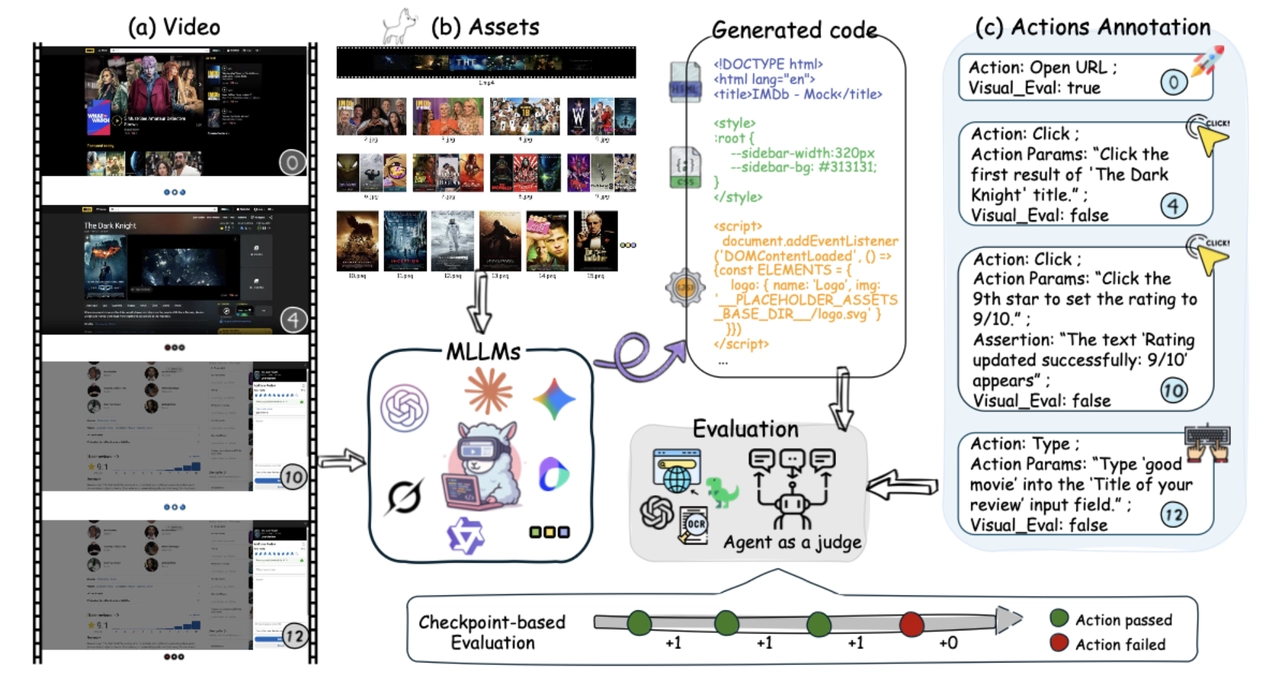
The Leap to True Functionality
Going from a static screenshot to a dynamic video is like going from understanding a photograph of a car to understanding how its engine works. Unlike previous benchmarks that focused on static images or lacked the necessary assets, IWR-Bench creates a truly realistic test environment that presents two massive challenges for today’s AI.
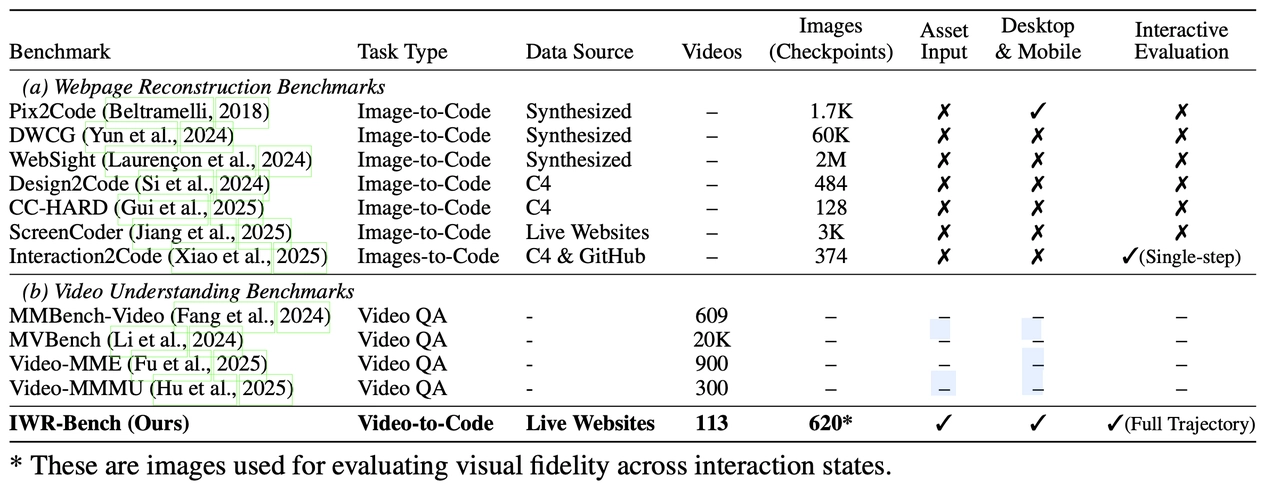
IWR-Bench is the first benchmark of its kind, bridging the gap between static webpage reconstruction and general video understanding benchmarks.
Seeing Isn't Enough—It Has to Understand Logic: The AI can’t just perceive pixels; it must perform multi-modal reasoning. It needs to watch the video, see a mouse click on a button, observe the UI change that follows, and connect that cause-and-effect to the specific button in the provided static assets. It’s a complex detective game of inferring the hidden logic behind the visuals.
From Logic to Living Code: After inferring the logic, the model must translate it into functional code (HTML, CSS, and event-driven JavaScript). This is trivial for a simple "About Us" page but becomes incredibly difficult for complex applications like e-commerce filtering, multi-step booking forms, or even web-based games like 2048, which are included in our benchmark.
Building a Fair and Challenging Test
To truly test these capabilities, IWR-Bench was built from the ground up through a meticulous, multi-stage curation process to be realistic and demanding.
Our four-stage construction pipeline ensures that every task in IWR-Bench is realistic, verifiable, and of high quality.
Real-World Scenarios: We curated 113 tasks from 100 real-world websites, from e-commerce and booking sites to productivity tools and games.
Complete Information: Unlike other benchmarks, we provide everything a real developer would have: the user interaction video _and_ all the static assets (images, icons, etc.) crawled from the site.
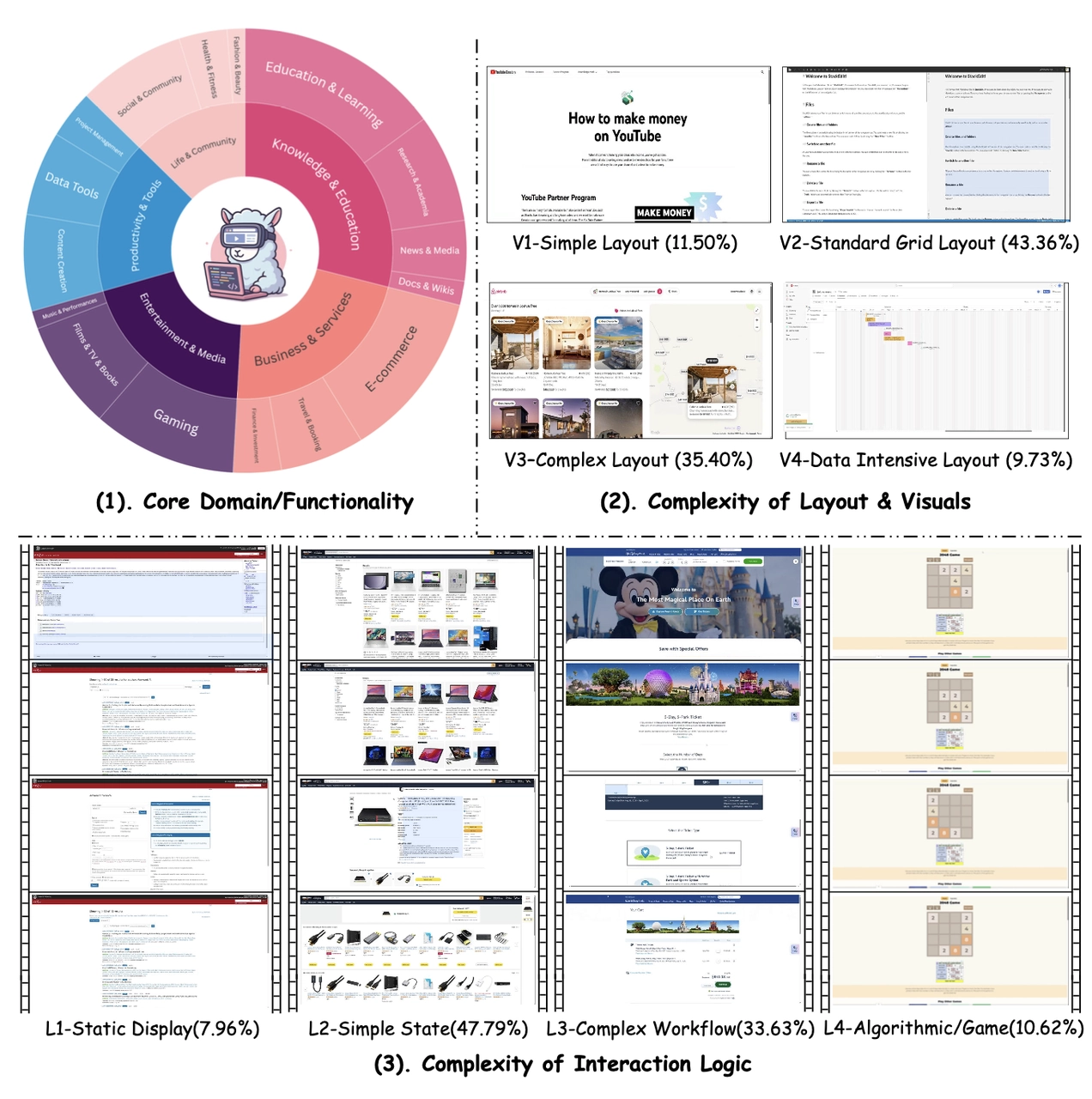
Multi-Dimensional Difficulty: We taxonomized tasks across three axes: visual complexity (is it a simple blog or a data-dense dashboard?), interaction complexity (is it just scrolling, or complex game logic?), and application domain.
Tasks in IWR-Bench are meticulously organized by domain, visual complexity, and interaction logic to ensure a comprehensive evaluation of model capabilities.
The Ultimate Referee: "Agent-as-a-Judge"
How do you grade something this complex? You can't just compare pixels. You have to actually _use_ the website.
So, we built an automated evaluation framework we call the "agent-as-a-judge." This AI agent acts like a QA tester. It programmatically visits the webpage generated by the model and attempts to perform the exact same sequence of actions shown in the original video. It then calculates two key scores:
Interactive Functionality Score (IFS): A measure of what works. Did the button clicks, text inputs, and other actions execute correctly?
Visual Fidelity Score (VFS): A measure of what it looks like. Does the generated page visually match the original at key checkpoints?
The final score is a weighted combination of these two, with a heavy emphasis on functionality. After all, a beautiful button that doesn't work isn't very useful.
Results
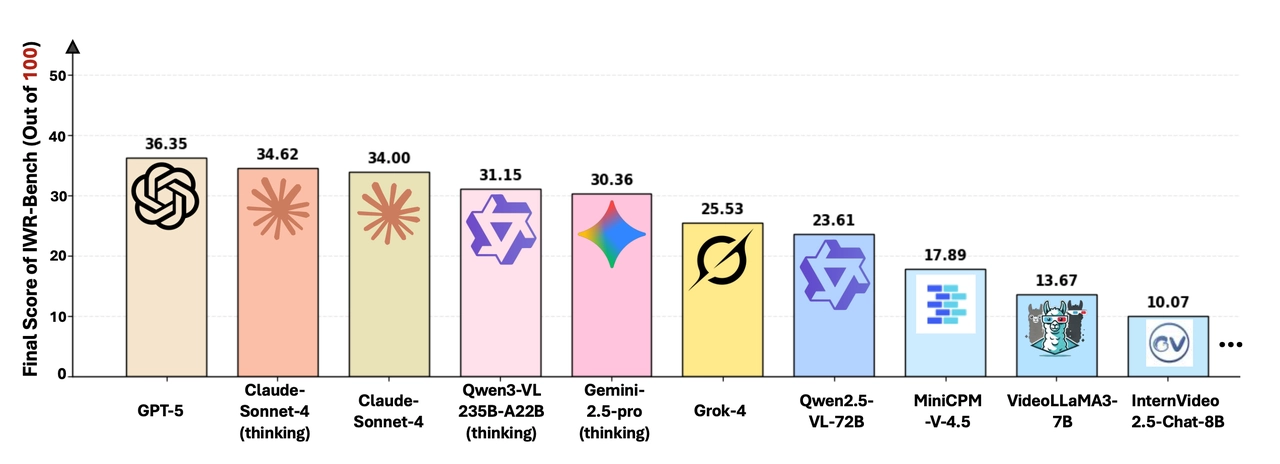
We tested 28 of the world's leading LVLMs, including proprietary models like GPT-5 and Claude-4, and the results were stunning. The main takeaway: reconstructing interactive functionality is still an incredibly difficult challenge for AI.
The performance of top AI models on IWR-Bench highlights the immense difficulty of the task, with the best-performing model, GPT-5, achieving an overall score of only 36.35 out of 100. More telling, as the detailed results show, is the massive gap between looks and logic: while top models achieved a respectable 64.25 on Visual Fidelity, their score for Functional Correctness was a mere 24.39.
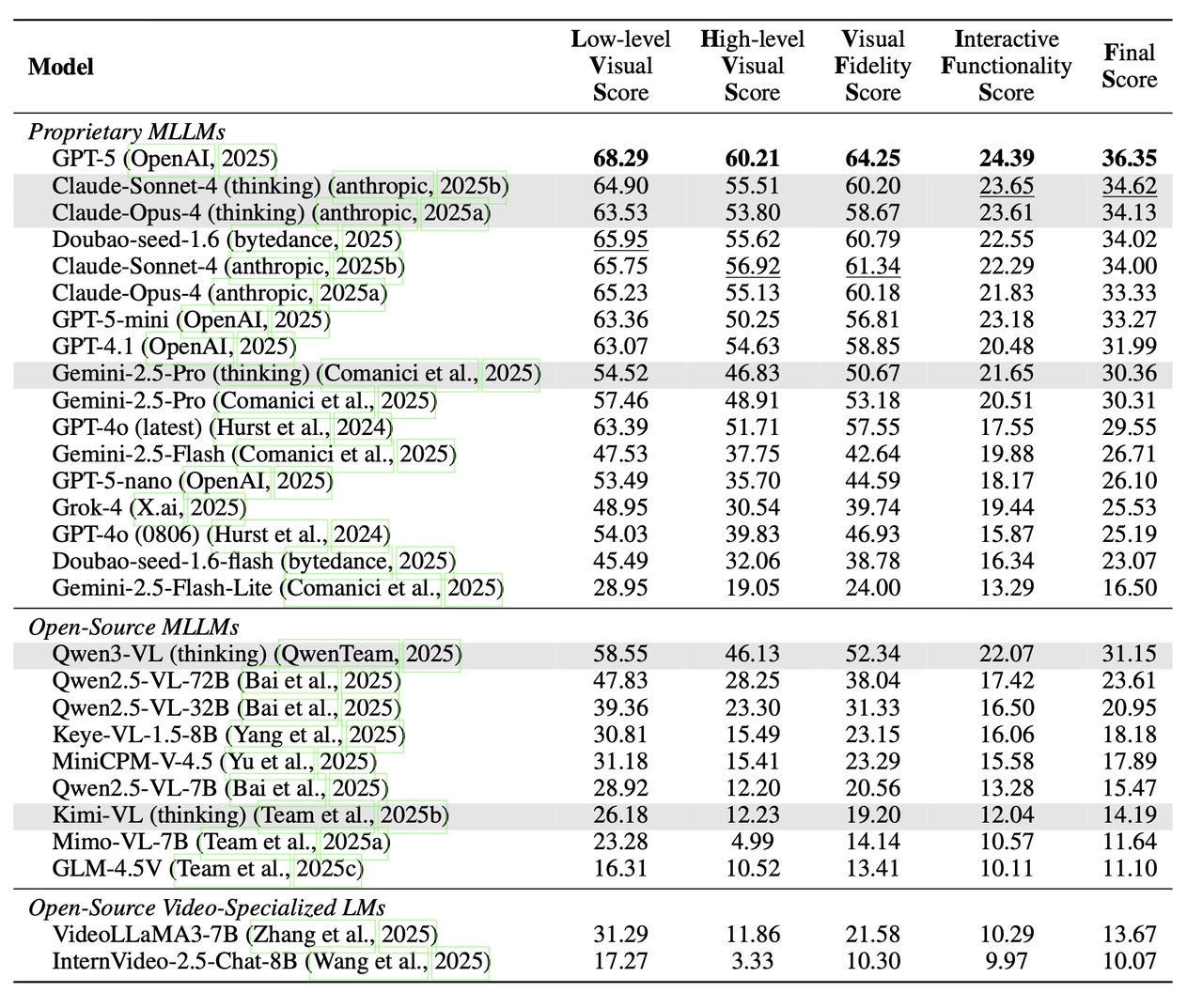
A detailed breakdown of the results reveals a critical insight: models are far better at replicating visual fidelity than they are at implementing functional logic.
This is the core finding of our work. In simple terms: AI is getting good at painting the car, but it's still struggling to build the engine. Models can replicate the static appearance of a webpage, but synthesizing the event-driven logic that makes it work remains a major hurdle.
Roadmap for the Future of AI
By highlighting this critical gap between appearance and functionality, IWR-Bench provides a clear and challenging new direction for vision-language research.
The next great leap for LVLMs will be to move beyond static perception and master temporal reasoning, dynamic logic, and the synthesis of functional code. By open-sourcing IWR-Bench, we hope to provide the community with the tools to measure progress and accelerate innovation on this exciting frontier.